Skip to content
Menu

China Top 10Gb SFP Cable Suppliers for Global Buyers

Choosing a 10gb Sfp Cable supplier is not simply a matter of comparing prices. Global buyers must weigh compatibility, measured performance, documentation, lead times, and support after delivery. A cable that fits the port may still fail to meet a network’s distance, power, or temperature requirements. Small details matter: connector labeling, bend radius, and the clarity of the product datasheet can all affect deployment.

Ethernet pioneer Bob Metcalfe is widely credited with the phrase, “Ethernet is the plumbing of the Internet.” The comparison suits high-speed cabling: reliable connections often go unnoticed until they fail. For buyers, that means checking each supplier’s testing practices and confirming compatibility with the specific switches and servers in use. Ask for clear specifications, warranty terms, and evidence that the stated link length and data rate have been tested. A polished catalog is not proof.

This guide examines ten China-based suppliers serving international buyers, with attention to product range, technical information, customization, and export experience. Supplier claims should still be verified directly. Not every listing provides enough detail, and that gap deserves scrutiny. Price matters, of course. So does the cost of replacing a cable after installation. The aim is a practical shortlist, not a blanket endorsement: requirements differ across data centers, enterprise networks, and industrial sites. Check the details before ordering.
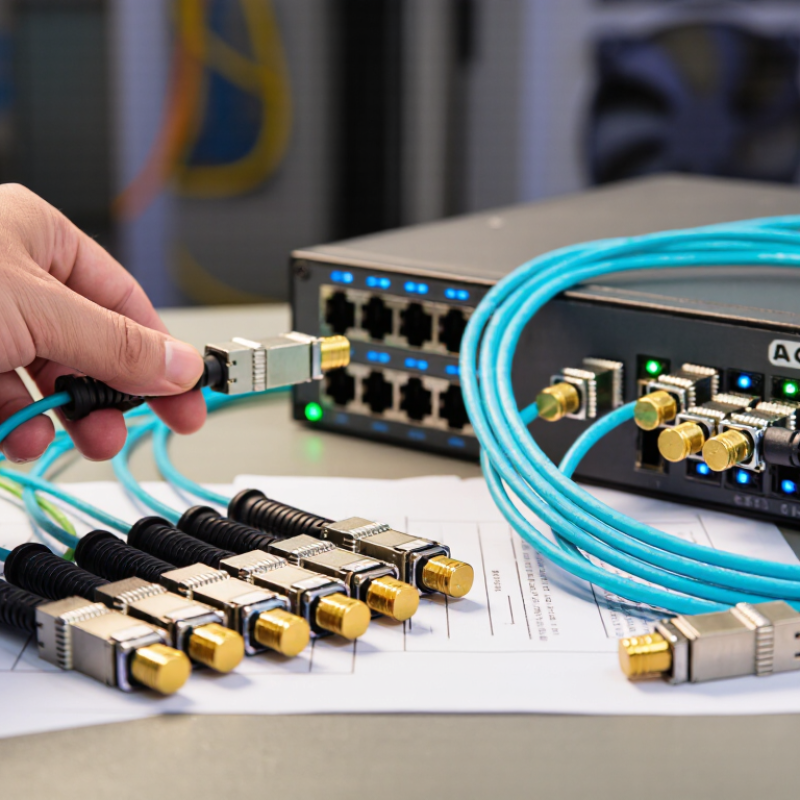
China Top 10Gb SFP Cable Suppliers for Global Buyers

Understanding 10Gb SFP Cables and Their Applications

Understanding 10Gb SFP Cables and Their Applications

A 10Gb SFP cable usually refers to a 10-Gigabit link built around an SFP+ interface. It may be a short copper direct-attach cable, an active optical cable, or fiber connected to separate transceivers. Copper DACs suit nearby switches in the same rack. Fiber links can cover longer runs between racks or rooms, depending on the optics and fiber type. Check both port compatibility and distance limits; the connector fitting is not proof that the link will work.

These cables support switch-to-server connections, storage networks, and data-center uplinks where steady throughput matters. Cisco’s Global Cloud Index forecast 20.6 zettabytes of annual data-center traffic by 2021, up from 6.8 zettabytes in 2016. This is a historical forecast, not a current measurement, but it illustrates the growth pressure on network capacity. A 10Gb link can help serve a defined workload; it will not fix congestion elsewhere. One detail is easy to miss: actual performance also depends on port settings, cable quality, and the network design.

Tips: Measure the route before choosing DAC or fiber. Leave room for bends and airflow. Test the complete link under load; a link light alone is not enough. Small oversights can cost time.

Key Specifications for Choosing the Right SFP Cable

For 10Gb SFP+ links, start with the host port, not the cable price. IEEE 802.3-2022 specifies a 10.3125 Gb/s serial line rate for 10GBASE-R. The cable and connected equipment must support compatible signaling. SFF-8431, the SFP+ interface specification, details electrical and module requirements for interoperability checks. Fit matters. Confirm connector type, passive or active DAC design, and supported length at both ends.

Distance changes the choice. IEEE 802.3-2022 specifies 10GBASE-SR reach up to 300 m on OM3 and 400 m on OM4 multimode fiber; these figures do not apply to copper DACs. For short rack connections, compare passive DAC options. For longer paths, check optical modules and fiber type. Measure the route, including service loops. Review power budget, bend radius, temperature range, and compatibility, then test link stability under load. Small omissions matter. A cable that works on a desk may struggle in a warm, crowded cabinet. Published reach is a limit, not a guarantee; routing and connector condition still need attention.

China Top 10Gb SFP Cable Suppliers for Global Buyers - Key Specifications for Choosing the Right SFP Cable

10Gb/s SFP+ cable and optical-link specification comparison

Link Configuration Media Interface / Wavelength Typical Reach Key Buyer Checks
Passive SFP+ DAC, 1–3 m Twinax copper Direct-attach electrical connection; no optical wavelength Assembly length, 1–3 m Confirm SFP+ port compatibility, cable length, and host-device qualification.
Passive SFP+ DAC, 5 m Twinax copper Direct-attach electrical connection; no optical wavelength 5 m assembly Check that the exact cable length is supported by both connected devices; passive DAC reach is implementation-dependent.
Passive SFP+ DAC, 7 m Twinax copper Direct-attach electrical connection; no optical wavelength 7 m assembly, where supported Long passive DACs are not supported by every platform. Request confirmation for the specific switch and NIC ports.
Active SFP+ DAC, 5 m Twinax copper with active electronics Direct-attach electrical connection; no optical wavelength 5 m assembly Verify device compatibility, power requirements, and whether active-cable support is required by the host.
Active SFP+ DAC, 10 m Twinax copper with active electronics Direct-attach electrical connection; no optical wavelength Up to 10 m in some product implementations Reach is product-specific, not a universal guarantee. Confirm the exact model’s supported distance and host compatibility.
10GBASE-SR over OM3 Multimode fiber, OM3 850 nm; typically duplex LC optical interfaces Up to 300 m Use compatible multimode fiber and matching 10GBASE-SR optics at both ends.
10GBASE-SR over OM4 Multimode fiber, OM4 850 nm; typically duplex LC optical interfaces Up to 400 m Check the installed fiber grade, connector cleanliness, and the transceiver’s supported reach.
10GBASE-LR Single-mode fiber 1310 nm; typically duplex LC optical interfaces Up to 10 km Confirm single-mode fiber compatibility and ensure both link endpoints use compatible 10GBASE-LR interfaces.
10GBASE-ER Single-mode fiber 1550 nm; typically duplex LC optical interfaces Up to 40 km Check link budget, optical attenuation, and platform support; extended-reach optics may require careful power-level planning.
SFP+ Active Optical Cable (AOC) Fixed fiber cable with integrated optical ends Optical conversion integrated into the cable ends Commonly available in lengths up to around 100 m; product-dependent Check fixed cable length, endpoint compatibility, and whether the application requires field-replaceable optical modules.

Selection note: This table compares common 10Gb/s SFP+ connection types; it is not a supplier ranking. Optical reach figures are standard maximums under specified conditions. DAC and AOC reach and device compatibility can vary by implementation, so verify the exact cable specification and host support before ordering.

How to Evaluate China-Based SFP Cable Suppliers

A reliable China-based 10Gb SFP cable supplier should explain more than price and delivery time. Ask whether the cable is passive copper or active optical, and confirm the exact length and host-device compatibility. Request sample test results, operating-temperature limits, and clear warranty terms. Check whether production batches can be traced to inspection records. A neat datasheet helps, but it cannot replace a sample.

Tips: Test a sample in your own switch or test setup. Check link stability, cable fit, and performance after several hours of use. Ask for written confirmation of lead times and packaging. Keep the answers. They are useful if specifications change.

One detail is easy to miss: cable routing. Tight bends or crowded racks can affect installation and, depending on cable type, performance. Ask for the minimum bend radius and handling guidance. Compare supplier responses for specific evidence, not just confident wording. No checklist removes every risk, and a polished sample may not represent every production batch. For a larger order, agree on acceptance checks before shipment.

Comparing Supplier Quality, Pricing, and Certifications

Comparing 10Gb SFP cable suppliers means looking beyond the quoted price. Ask for cable length, conductor type, connector details, and tested operating temperature. For a short rack connection, a passive copper cable may be economical; longer runs or different layouts may call for another design. Check that the supplier confirms compatibility with your equipment, rather than relying on a broad “works with most systems” claim. Small details matter.

Quality is easier to judge when suppliers share measurable evidence. Request test results for signal performance, continuity, and connector fit, plus a clear warranty and traceable product specifications. A neatly finished cable should have secure connectors and legible labels. Still, a polished sample does not prove every production batch will match. Ask how the supplier handles inspection and defective units. Not always obvious.

Compare certifications carefully. Ask which standards or quality systems apply to the cable, and verify certificates with the issuing organization when possible. A certificate for a factory process does not automatically certify every cable specification. Pricing should include packaging, sample fees, shipping, and replacement terms, not just the unit cost. I would compare quotes in a simple table, though exact apples-to-apples comparisons can be awkward when suppliers define testing differently. A little extra checking can prevent mismatched cables and avoidable downtime.

Global Sourcing, Shipping, and After-Sales Support

For global buyers, sourcing 10Gb SFP cables starts with system requirements, not simply the lowest quote. Check connector type, cable length, passive or active design, and host-device compatibility. Ask suppliers to confirm supported equipment and operating conditions in writing. Small details matter. A short copper cable may suit a rack, while a longer route may require another solution. Request a sample and test the link under real workloads before placing a large order.

Shipping plans deserve equal attention. Confirm production lead time, carton quantity, gross weight, and dispatch terms before payment. For urgent projects, split shipments can help protect installation schedules, though they may increase freight costs. Ask for tracking details and destination-appropriate paperwork. Packaging should protect connectors and prevent cable jackets from being crushed. Customs delays still happen. Leave a buffer; estimates are not guarantees.

Agree on after-sales responsibilities before purchasing. Keep test results, product labels, and order records together. If a link fails, share the port model, cable length, error logs, and clear photos of both ends. A capable supplier should provide troubleshooting steps and explain replacement procedures. Some cases take longer than expected. Discuss response times in advance, and review your own compatibility assumptions when problems arise.