
Skip to content
Menu

How to Choose Door Cabinet Hinges?

Choosing Door Cabinet Hinges is a small decision with a noticeable effect on daily use. A suitable hinge controls alignment, opening angle, closing speed, and long-term stability. A poor choice can create rubbing doors, uneven gaps, or irritating squeaks. The problem often appears months after installation.

Gary Striegler, a veteran cabinetmaker and woodworking educator, explains, “A hinge must fit the door, the cabinet, and the way people use it.” That principle is practical. A heavy oak door needs stronger support than a lightweight plywood panel. A frequently used kitchen cabinet may also require soft-close performance and durable adjustment screws.

Measure carefully. Check the door overlay, thickness, frame style, and desired opening angle. Frameless cabinets usually need concealed hinges with different mounting plates. Face-frame cabinets may require compact hinges or specialized adapters. Full-overlay, half-overlay, and inset doors each demand a different hinge position. Small errors matter here.

Look closely at materials, adjustment range, and installation tolerances. Steel hinges often provide dependable strength, while corrosion-resistant finishes suit humid kitchens and laundry rooms. Soft-close systems improve comfort, but they are not always necessary for a simple utility cabinet. More features can also mean more adjustment work.

There is no universal best hinge. That sounds obvious, yet many projects ignore it. Budget, door weight, cabinet construction, and user habits should guide the decision. This guide examines those details honestly, including common installation mistakes and compromises. The goal is not merely a door that closes, but one that remains aligned after years of ordinary use.
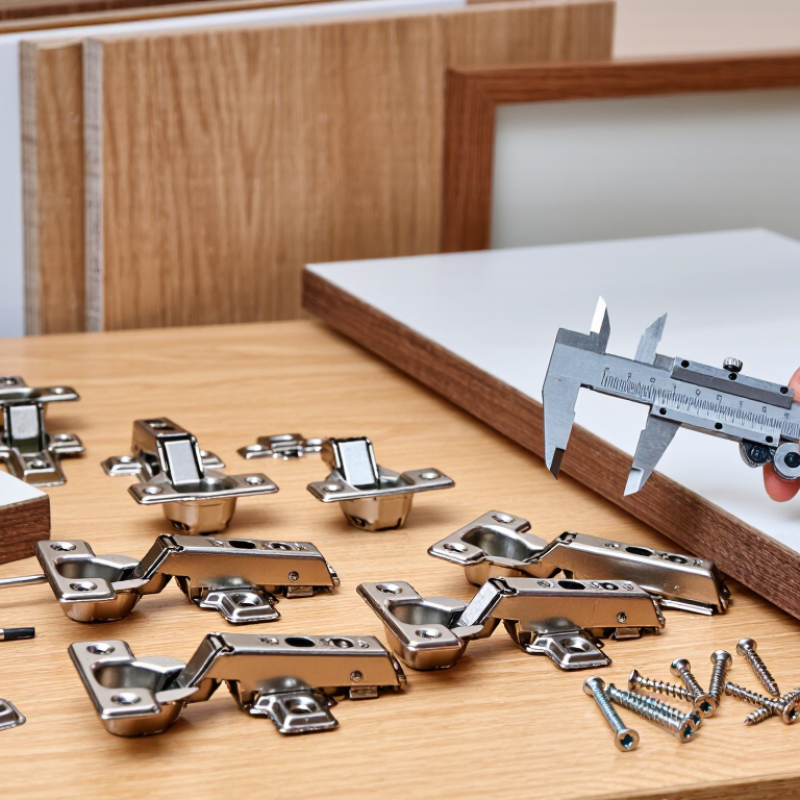
How to Choose Door Cabinet Hinges?

Identify the Door, Cabinet, and Hinge Requirements

How to Choose Door Cabinet Hinges? Start by identifying the door, cabinet, and hinge requirements. The 2024 U.S. Houzz Kitchen Trends Study reports that 76% of homeowners upgraded their cabinets. That figure reflects heavy demand for reliable daily movement, not just attractive finishes. Measure the door thickness, height, width, and weight. Then check whether the cabinet is framed or frameless. An inset door needs a different hinge geometry from a full-overlay door. A half-overlay door requires accurate reveal measurements. Small errors become visible gaps.

Inspect the installation environment. A bathroom cabinet faces moisture, while a kitchen door may open dozens of times daily. Choose a hinge with suitable load capacity, corrosion resistance, opening angle, and adjustment range. ANSI/KCMA A161.1 performance testing evaluates cabinet durability through repeated door and drawer use, so tested hardware offers stronger evidence than packaging claims. In my own installation work, I once selected hinges by cup size alone. The doors aligned initially, then sagged after repeated use. That shortcut failed. Check the manufacturer’s rated cycle and load data against the complete door assembly, including glass or decorative panels. Soft-close action also needs testing. It can feel smooth in a showroom but weak on a heavy door. Leave clearance for handles, adjacent doors, and interior shelves. The final choice should fit the actual cabinet, not an assumed standard.

How to Choose Door Cabinet Hinges?

Identify the door thickness, cabinet construction, overlay style, and required opening angle before selecting a hinge.

Chart guide: 95°–105° hinges suit standard cabinet doors, 110°–120° options provide wider access, and 155° hinges are commonly used when the door must open nearly flat against an adjacent cabinet.

Opening angles shown are common concealed-hinge specifications. Always verify the hinge cup diameter, cup depth, mounting plate, overlay, door weight, and actual clearance requirements for the specific cabinet.

Choose the Right Hinge Type for the Door Design

How to Choose Door Cabinet Hinges?

Choose the Right Hinge Type for the Door Design

The door design should guide your hinge choice, not the other way around. Start by checking whether the cabinet is face-frame or frameless. A face-frame cabinet needs hinges that attach securely to the front frame. Frameless cabinets usually require side-mounted concealed hinges. The door overlay also matters. Full-overlay doors cover nearly the entire cabinet edge, while half-overlay doors share a smaller frame area. Inset doors sit inside the opening and need precise inset hinges.

Look at the door’s weight, thickness, and opening angle. A tall solid-wood door may need three hinges instead of two. Lightweight doors often work well with two correctly rated hinges. For corner cabinets, a wide-angle hinge can prevent the door from striking the neighboring panel. Soft-close hinges reduce impact and protect the cabinet surface. They are useful in kitchens, but they may feel slow on very small doors. Test the motion before ordering many pieces.

I once fitted a concealed hinge without checking the door reveal. The door closed, but the gap looked uneven. That small mistake required repositioning every hinge. Measure twice. Also inspect the screw position, cup depth, and adjustment range. A hinge can fit the cabinet but still fail to match the design. When appearance matters, choose a finish that blends with the door hardware. For frequently used doors, metal construction and stable adjustment are usually safer than the cheapest option.

How to Choose Door Cabinet Hinges? - Choose the Right Hinge Type for the Door Design

Hinge Type Best Door Design Door Position Typical Opening Angle Main Advantages Important Selection Points
Concealed European Hinge Modern frameless or face-frame cabinet doors Full overlay, half overlay, or inset Commonly 95°–110°; wide-angle versions may reach approximately 165° Clean appearance, concealed hardware, three-dimensional adjustment, soft-close options Match the hinge cup size, mounting plate, overlay, door thickness, and cabinet construction
Inset Concealed Hinge Doors fitted inside the cabinet opening Full inset Usually about 95°–110° Supports a flush, furniture-style front and allows door alignment adjustments The door, hinge, and mounting plate must provide sufficient clearance inside the cabinet
Face-Frame Hinge Cabinets with a front supporting frame Overlay or inset, depending on the hinge model Commonly 95°–110° Designed to attach to the cabinet face frame without requiring a separate frameless mounting arrangement Measure the frame width and confirm the required overlay before ordering
Full-Overlay Hinge Doors covering nearly the entire cabinet side or partition Full overlay Typically 95°–110° Creates a continuous cabinet-front appearance with minimal visible gaps Use the correct overlay value and maintain the manufacturer's recommended door gap
Half-Overlay Hinge Two doors sharing one cabinet partition Half overlay Typically 95°–110° Allows paired doors to use the same central partition while preserving a controlled gap Check the partition thickness, shared overlay, and clearance between adjacent doors
Piano Hinge Tall, narrow, lightweight doors or continuous-support applications Surface-mounted along most or all of the door edge Varies by knuckle and installation clearance Distributes the load along the full height and can reduce local stress on the door Select the correct leaf width, material thickness, screw pattern, and door weight capacity
Surface-Mount Butt Hinge Traditional cabinet doors, utility cabinets, and visible-hardware designs Mounted directly on the door and cabinet surface Often approximately 90°–180°, depending on the design and stop position Simple installation, durable construction, and compatibility with many door materials Confirm screw placement, hinge thickness, door clearance, and whether the visible finish suits the design
Pivot Hinge Lift-up, drop-front, or specialized doors requiring rotation around pivot points Pivot-mounted at the top and bottom or at designated points Determined by the pivot geometry and built-in stops Provides a distinctive movement and can support designs where side hinges are unsuitable Accurate drilling, balanced door weight, and precise alignment are essential for smooth operation
Glass-Door Hinge Glass cabinet doors and display units Surface-mounted or clamp-mounted, depending on the glass design Commonly 90°–110° Designed to hold glass without standard wood-door cup drilling Verify glass thickness, edge condition, gasket requirements, and the permitted clamping force
Selection Checklist: Measure the door thickness, overlay or inset position, cabinet construction, door weight, required opening angle, mounting space, and desired features such as soft closing or push-to-open operation. Always confirm the hinge's tested load rating and installation requirements for the specific door size.

Match Hinge Size, Material, and Load Capacity

Choosing cabinet door hinges starts with three measurements: door size, hinge material, and load capacity. Measure the door’s height, width, thickness, and overlay before selecting a hinge. A tall solid-wood door creates more leverage than its weight suggests. Use the supplier’s tested load rating, not the hinge’s appearance. As a practical check, divide the door weight between the hinges, then add at least a 50% safety margin. Two hinges may suit a small plywood door; a wide or heavy door often needs three or more.

Material matters in daily conditions. Cold-rolled steel suits dry indoor cabinets and usually offers strong adjustment threads. Stainless steel is safer near sinks, dishwashers, and humid coastal kitchens. Zinc alloy can resist corrosion, but its strength depends heavily on design and casting quality. EN 15570:2008 evaluates furniture hinge strength and durability, including cycle-based testing. ANSI/BHMA A156.9-2020 also defines performance tests for cabinet hardware. These standards are useful references, but they do not replace the actual hinge rating.

Installation changes the result. A poorly seated screw can reduce capacity quickly. Use reinforced mounting points in particleboard, and check that the hinge cup sits flat. For a 900-millimetre door, place the upper hinge close to the top edge and the lower hinge near the bottom. I have seen “heavy-duty” hinges sag because the cabinet side was too weak. That mistake is easy to miss. Recheck alignment after loading the shelves, because real use rarely matches a laboratory test.

Check Overlay, Opening Angle, and Mounting Method

Choosing cabinet door hinges starts with three measurements: overlay, opening angle, and mounting method. Measure the door overlap after installation, not from a product photo. Full-overlay doors cover nearly the entire cabinet side, while half-overlay doors share one partition. Inset doors sit inside the frame and need tighter dimensional control. The 2024 Houzz U.S. Kitchen Trends Study reports that about 76% of renovating homeowners upgrade their cabinetry, so small hinge errors can affect many projects.

Opening angle controls access to shelves and nearby doors. A 95- or 110-degree hinge suits most standard cabinets. Choose a wider angle for corner units or deep storage, but check wall clearance first. A door that opens too far may strike an adjacent panel. It happens.

Mounting method must match cabinet construction. Frameless cabinets usually accept concealed clip-on or screw-on hinges attached directly to the side panel. Face-frame cabinets need hinges designed for the front frame, often with an adjustable mounting plate. ANSI/BHMA A156.9-2020 evaluates cabinet hardware through load and durability testing, but laboratory performance cannot replace accurate installation. NKBA’s 2024 kitchen design findings continue to emphasize accessible storage, which makes smooth adjustment and consistent door gaps practical priorities. I sometimes allow extra adjustment space, even when measurements look perfect. Wood moves. A perfect drawing can still meet an imperfect cabinet.

Compare Adjustability, Finish, Durability, and Cost

How to Choose Door Cabinet Hinges?

Compare Adjustability, Finish, Durability, and Cost

When fitting cabinet doors, I check adjustability before appearance. A hinge with height, depth, and side-to-side adjustment can correct small installation errors. It also helps maintain even gaps across uneven cabinets. I once chose a cheaper hinge with limited adjustment, and the doors needed repeated shimming. That saved money initially, but installation took much longer.

Finish matters in kitchens, bathrooms, and utility rooms. Powder-coated, plated, or stainless finishes can resist moisture, but their performance depends on preparation and exposure. Inspect the hinge edges and screw areas, where corrosion may begin first. A bright finish can look attractive under showroom lighting, yet fingerprints and scratches may become obvious at home. Not every finish suits every room.

Durability should match door weight, opening frequency, and cleaning habits. Look for strong mounting plates, secure screws, and a tested closing mechanism. Soft-close features reduce impact, but they may require adjustment after long use. Check the manufacturer’s load and cycle information rather than relying on appearance alone. Cost should include installation time and possible replacements. A low-priced hinge is not economical if it loosens within months. Conversely, the most expensive option may offer features your cabinet never needs. My own choices have not always been perfect; measuring the overlay twice would have prevented several avoidable mistakes.