
Skip to content
Menu

China Top 10 Stainless Steel Coil Manufacturers?

Choosing among China’s top stainless steel coil suppliers requires more than comparing prices. A reliable Stainless Steel Coil Manufacturer should demonstrate stable chemistry, controlled rolling, and consistent surface quality. This guide introduces ten notable manufacturers through practical purchasing criteria, not advertising language. It considers production capacity, alloy range, coil dimensions, finishes, export experience, and after-sales communication. Buyers can use the list as a starting point.

The review looks for evidence. Relevant documents may include mill test certificates, inspection reports, and traceability records. Factory capabilities also matter. Annealing lines, pickling equipment, slitting accuracy, and warehouse protection can affect the final coil. A 2B surface should arrive clean, not marked by careless wrapping. Thickness tolerance and edge condition deserve equal attention. Suppliers serving construction, food equipment, automotive, and chemical projects may require different grades, including 304, 316L, or 430. Technical support should explain these choices clearly.

No ranking is permanent. Prices, lead times, capacity, and certifications can change. Some companies present impressive catalogs, yet response quality may weaken after an order is placed. That risk deserves attention. We encourage readers to request recent samples, production photos, independent inspections, and detailed quotations. Compare more than the lowest number. A strong supplier communicates limitations honestly and confirms details before production. This introduction cannot replace due diligence, but it can make the first conversation more focused, measurable, and realistic.
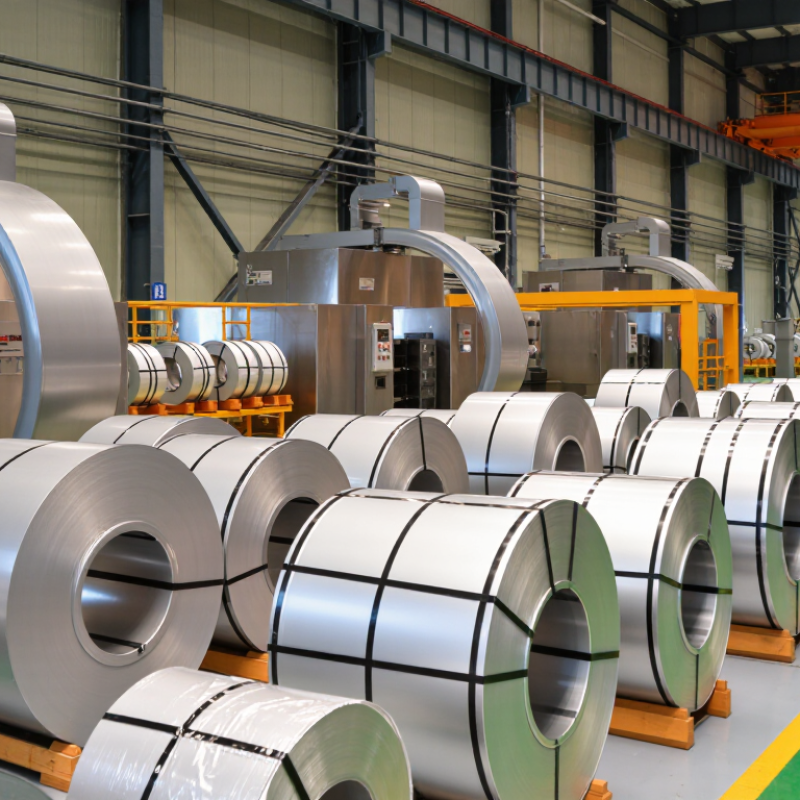
China Top 10 Stainless Steel Coil Manufacturers?

What Defines a Leading Stainless Steel Coil Manufacturer in China

A leading Chinese stainless steel coil manufacturer is defined by more than production volume. It must control chemistry, heat treatment, surface finish, and delivery evidence.

Production scale matters.

The ISSF’s 2024 statistics recorded 62.6 million tonnes of global stainless crude steel production. That volume intensifies competition, but it does not prove consistent coil quality.

A serious producer shows heat numbers, inspection records, and traceability from slab to packed coil. Buyers should request:

  • Mill certificates
  • Tensile results
  • Thickness tolerances
  • Surface photographs

Small details expose big gaps.

Process discipline separates dependable mills from merely large ones.

ISO Survey data shows more than 1.5 million ISO 9001 certificates worldwide in 2023. Certification alone is insufficient.

Auditors and experienced buyers
Corrective-action records
Calibration routines
Batch consistency

Auditors and experienced buyers should examine corrective-action records, calibration routines, and batch consistency. For export orders, reliable manufacturers maintain stable lead times, seaworthy packaging, and clear responses to claims.

These are practical signals of experience, not marketing language.

Technical capability should match the application.

A manufacturer supplying 304 or 316L coils should explain nickel, chromium, molybdenum, and carbon controls clearly. The World Stainless Association links corrosion resistance to alloy composition and surface condition.

I would also question unusually low quotations. They may reflect thinner gauge, weaker inspection, or uncertain traceability.

That concern is not always fair, but ignoring it is worse.

A leading supplier should welcome difficult questions and provide measurable answers.

Key Production Regions and Manufacturing Capabilities

China’s stainless steel coil industry is concentrated in several strong production regions. Jiangsu and Zhejiang support large integrated mills, with nearby ports and established metal-processing networks. Fujian and Guangdong serve export-oriented buyers and appliance manufacturers. Shandong adds substantial capacity for hot-rolled and cold-rolled coil products. Shanghai and surrounding areas contribute engineering services, testing, and logistics coordination.

It starts upstream. Many capable producers control melting, refining, continuous casting, and slab preparation. Advanced facilities use AOD or similar refining systems to manage carbon, sulfur, and alloy consistency. Hot rolling creates the initial coil, while cold rolling improves thickness control and surface quality. Annealing, pickling, tension leveling, and slitting support different end-use requirements. Common grades include 304, 316L, 201, and ferritic options, depending on corrosion and forming needs.

A credible supplier should provide heat numbers, mill test certificates, dimensional records, and surface inspection data. In practical purchasing work, traceability often matters more than a polished factory presentation. Port access can reduce lead times, but inland plants may offer stronger technical control or flexible production scheduling. No region is perfect. Some facilities have excellent equipment but uneven communication. Others respond quickly but lack stable process records. Buyers should compare sample coils, thickness tolerance, edge condition, finish consistency, and after-sales handling before ranking manufacturers. One overlooked detail is packaging: damaged corners or wet wrapping can weaken an otherwise compliant shipment.

China’s Top Stainless Steel Coil Manufacturers by Market Role

China’s top stainless steel coil manufacturers are better understood by market role than by a simple ranking. Integrated mills lead high-volume production, offering stable chemistry, wide coils, and consistent heat treatment. Export-oriented producers focus on packaging, documentation, and reliable shipping schedules. Some manufacturers serve demanding engineering sectors with tight thickness tolerance and controlled surface finishes.

Precision processors occupy another important role. They slit master coils into narrow widths, level sheets, or provide custom edging for fabricators. Cold-rolled specialists commonly supply 2B, BA, and brushed finishes, while hot-rolled producers support tanks, structural parts, and industrial equipment. Coil quality depends on more than appearance. Buyers should review mill test certificates, heat numbers, surface inspection records, and packing photographs. Small details matter.

The remaining market roles include welded-component suppliers, decorative-finish producers, and project-based manufacturers. These companies may handle short runs better than large mills. A practical evaluation should compare grade control, monthly capacity, lead time, after-sales response, and traceability. Ask how coils are protected against moisture during sea transport. Also check whether the stated tolerance matches the actual inspection method.

No shortlist is perfect. A large supplier may be less flexible. A smaller processor may offer closer technical support but weaker delivery resilience. I have found that sample testing often reveals more than polished brochures. Verify flatness, hardness, surface uniformity, and coil weight before committing to repeated orders.

China’s Stainless Steel Coil Market: Top 10 Common Grades by Chromium Content

Representative nominal chromium content of stainless steel grades commonly supplied in coil form

Chromium is the defining alloying element that gives stainless steel its corrosion resistance. The values shown are representative nominal chromium levels commonly associated with standard grades; exact specifications may vary by applicable ASTM, EN, or GB standard and product mill certificate.

Stainless Steel Grades, Finishes, and Product Specifications

When comparing China’s top 10 stainless steel coil manufacturers, buyers should examine material details before production claims. Common grades include 304 for general corrosion resistance, 316 for chloride exposure, and 430 for economical indoor applications. Duplex grades offer higher strength, but welding procedures need closer control. Grade selection should match temperature, chemicals, forming needs, and service life. A mill certificate should confirm chemical composition, mechanical properties, heat number, and inspection results. Not just a sales sheet.

Surface finish changes both appearance and performance. 2B provides a smooth, cold-rolled surface for equipment and fabrication. BA offers a brighter reflection, while No. 4 creates a directional brushed texture. Hot-rolled No. 1 remains practical for heavy industrial parts. Coil specifications should state thickness, width, inner diameter, outer diameter, coil weight, edge condition, tolerance, and packaging. Ask whether measurements follow recognized standards. Small tolerance differences can disrupt slitting or stamping. In practice, even a clean coil may show handling marks. I would not promise perfection without inspection photos and sampling.

Tips: Request a sample coil or cut piece before signing a large order. Compare finish under neutral light, not showroom lighting. Check flatness, burrs, rust stains, and protective film adhesion. Keep records of heat numbers and test reports. If the application involves salt spray, food contact, or high heat, obtain suitability evidence from an independent laboratory. A low price can hide inconsistent thickness. That lesson is easy to overlook.

China Top 10 Stainless Steel Coil Manufacturers? - Stainless Steel Grades, Finishes, and Product Specifications

The following table presents ten representative stainless steel coil product profiles commonly manufactured and supplied in China. Specifications are based on widely used ASTM, ASME, EN, and JIS designations. Actual availability, tolerances, coil weight, and surface condition should be confirmed against the applicable mill test certificate and purchase specification.

No. Product Profile Grade & UNS Typical Chemical Characteristics Common Standards Available Finish Typical Thickness Typical Width Typical Applications
1 Austenitic General-Purpose Coil 304 / UNS S30400 Approximately 18% Cr and 8% Ni; non-magnetic in the annealed condition ASTM A240; ASTM A480; EN 10088-2; JIS G4304 2B, BA, No. 1, No. 4, HL, 8K 0.20–6.00 mm 600–2,000 mm Kitchen equipment, food-processing equipment, tanks, architectural components
2 Low-Carbon Austenitic Coil 304L / UNS S30403 18% Cr and 8% Ni class; reduced carbon content for improved weldability ASTM A240; ASME SA240; EN 10088-2 2B, BA, No. 1, No. 4, HL 0.30–6.00 mm 600–2,000 mm Welded vessels, piping, heat exchangers, pharmaceutical and dairy equipment
3 Molybdenum-Bearing Corrosion-Resistant Coil 316 / UNS S31600 Approximately 16–18% Cr, 10–14% Ni, and 2–3% Mo ASTM A240; ASTM A480; EN 10088-2; JIS G4304 2B, BA, No. 1, No. 4, HL, 8K 0.30–6.00 mm 600–2,000 mm Marine hardware, chemical equipment, coastal construction, food and beverage systems
4 Weldable Molybdenum-Bearing Coil 316L / UNS S31603 16–18% Cr, 10–14% Ni, 2–3% Mo, with reduced carbon content ASTM A240; ASME SA240; EN 10088-2 2B, BA, No. 1, No. 4, HL 0.40–6.00 mm 600–2,000 mm Pressure vessels, welded process equipment, desalination and marine installations
5 Ferritic Decorative Coil 430 / UNS S43000 Approximately 16–18% Cr; nickel-free ferritic stainless steel ASTM A240; ASTM A480; EN 10088-2; JIS G4304 2B, BA, No. 4, HL, mirror-polished 0.30–3.00 mm 600–1,500 mm Appliance panels, kitchen trim, automotive components, interior decoration
6 Economic Austenitic Coil 201 / UNS S20100 Chromium-manganese-nickel alloy; lower nickel content than 304 ASTM A240; ASTM A666; EN 10088-2 2B, BA, No. 4, HL, 8K 0.30–4.00 mm 600–1,500 mm Indoor architectural trim, catering equipment, consumer products and general fabrication
7 Heat-Resistant Stabilized Coil 321 / UNS S32100 18–20% Cr and 9–12% Ni; titanium-stabilized against carbide precipitation ASTM A240; ASME SA240; EN 10088-2 2B, No. 1, No. 4, HL 0.50–6.00 mm 600–2,000 mm High-temperature ducting, exhaust systems, heat exchangers and chemical processing
8 Duplex Structural Coil 2205 / UNS S32205 Approximately 22% Cr, 5% Ni, and 3% Mo; ferritic-austenitic microstructure ASTM A240; ASTM A480; EN 10088-2 2B, No. 1, No. 4, HL 0.50–6.00 mm 600–2,000 mm Oil and gas equipment, pressure vessels, desalination, chemical tanks and structural components
9 High-Strength Martensitic Coil 410 / UNS S41000 Approximately 11.5–13.5% Cr; heat-treatable martensitic stainless steel ASTM A240; ASTM A480; EN 10088-2; JIS G4304 2B, No. 1, No. 4, polished 0.50–4.00 mm 600–1,500 mm Cutlery, valves, pump parts, fasteners and components requiring moderate wear resistance
10 High-Alloy Austenitic Coil 904L / UNS N08904 Approximately 19–23% Cr, 23–28% Ni, 4–5% Mo, with copper addition ASTM B625; ASTM B673; EN 10088-2 2B, BA, No. 1, No. 4, HL 0.50–4.00 mm 600–1,500 mm Sulfuric-acid service, chemical processing, pollution-control equipment and specialty tanks
Finish reference: No. 1 is hot-rolled, annealed and pickled; 2B is cold-rolled, heat-treated, pickled and skin-passed; BA is bright annealed; No. 4 is a brushed finish; HL is a directional hairline finish; 8K is a highly polished mirror finish.

How to Evaluate Suppliers, Quality Standards, and Export Services

When comparing China’s top stainless steel coil manufacturers, a ranking alone is not enough. A reliable evaluation begins with traceable production records, technical competence, and consistent export performance. Request the mill’s ISO 9001 certificate, recent material test certificates, and heat numbers matching the coil labels. Check whether the stated grade follows ASTM A240, EN 10088, or another agreed standard. Small details matter.

Inspect surface finish, thickness tolerance, width accuracy, and edge condition. For 2B or BA coils, ask for clear photographs under factory lighting, not carefully selected images only. Independent PMI testing can confirm nickel, chromium, and molybdenum content before shipment. A practical supplier should explain annealing, pickling, slitting, and inspection procedures in plain language. Vague answers are warning signs. So are unusually low quotations.

Export service deserves equal attention. Confirm coil weight, wooden or steel packaging, moisture protection, loading photographs, and document accuracy. The commercial invoice, packing list, certificate of origin, and bill of lading should match the contract. Ask how the supplier handles delayed vessels, damaged edges, or dimensional disputes. Written procedures matter more than confident promises. Yet even a strong factory may have occasional inconsistent packaging or delayed replies. That deserves honest discussion, not concealment. A trial order can reveal more than a long presentation. Examine the first coil on arrival, record its measurements, and compare them with the certificate. Supplier selection is not perfectly scientific. It still requires evidence, patience, and careful questions.