Skip to content
Menu

What Are the Top Types of Warehouse Racking Systems?

A Warehouse Racking System does more than store pallets. It shapes aisle width, picking routes, replenishment work, and the amount of usable space above the floor. Choosing one is a practical trade-off. Selective pallet racks offer direct access to each pallet, while drive-in designs can store more loads in less floor space. Push-back and pallet-flow systems support higher-density storage, but they depend on suitable inventory patterns and careful loading. Cantilever racks suit long items such as timber or pipe. Carton-flow shelving can bring small cartons closer to pickers. No single design fits every operation.

The stakes are real. MHI’s 2024 Annual Industry Report found that 55% of surveyed supply-chain leaders planned to invest more than $1 million in supply-chain innovation. That figure does not measure rack purchases specifically, but it signals a broader push to improve warehouse performance. Rack selection should still begin with the work on the floor: pallet dimensions, load weights, order frequency, equipment, and safe clearances. Space is expensive. So are avoidable handling steps. A layout may look efficient on paper, then frustrate pickers at the aisle end. That deserves a second look.

This guide compares the leading warehouse racking types, their advantages, limitations, and common uses. It also considers how storage density affects access and workflow. The best option is not always the densest one. A reliable decision matches the rack to real inventory and operating needs, with qualified professionals verifying load capacities and layout details.
What Are the Top Types of Warehouse Racking Systems?

What Warehouse Racking Systems Are and How They Work

Warehouse racking systems are engineered structures that store palletized goods above floor level. Upright frames support horizontal beams, creating bays and shelf levels. Forklifts place loads into these spaces, while workers retrieve items according to the facility’s picking process. Simple, but not effortless.

The rack type changes how inventory moves. Selective racks provide direct access to each pallet, which suits facilities handling many product lines. Drive-in racks allow forklifts to enter lanes and store pallets several positions deep. This saves floor space, but limits access to individual loads. Push-back and pallet-flow systems use carts or rollers to move pallets through sloped lanes, often supporting faster rotation.

A sound design starts with the inventory, not just the building’s dimensions. Planners consider pallet size, load weight, forklift turning space, ceiling height, and how often each item moves. Anchors secure frames to the floor, and beams need locking devices to resist accidental displacement. Clear labels help operators check load limits. A layout may look efficient on paper, yet feel cramped when a forklift turns with a full pallet. That detail deserves a real-world test. Racking also needs regular inspection for bent uprights, loose connections, and impact damage. Small defects matter.

Key Components and Storage Principles of Warehouse Racking

What Are the Top Types of Warehouse Racking Systems?

Key Components and Storage Principles of Warehouse Racking

A pallet rack is a structural system, not just a row of beams. Upright frames carry vertical loads; horizontal beams support pallets, while diagonal bracing helps stabilize each frame. Baseplates and floor anchors transfer forces to the slab. Wire decking, column guards, and load signs add practical protection and visibility. Small details matter. A bent connector or poorly seated beam can compromise a bay, so trained staff should inspect components regularly and follow the system’s rated capacities. ANSI MH16.1, maintained by the Rack Manufacturers Institute, sets engineering requirements for industrial steel storage racks.

Storage design balances access, density, and product flow. Selective racks make individual pallets easy to reach, while drive-in layouts trade some selectivity for denser storage. Match the choice to inventory turnover and handling equipment. Keep heavier loads low, respect beam and bay ratings, and preserve clearance for sprinklers and lift trucks. MHI’s 2024 Annual Industry Report found that 55% of surveyed supply-chain professionals were increasing technology investment. That points to growing interest in adaptable operations, but automation alone cannot fix poor slotting. Aisle widths, pallet dimensions, and replenishment habits still shape daily performance. The imperfect part: facilities often plan around peak volume, then discover the layout slows ordinary picking.

What Are the Top Types of Warehouse Racking Systems? - Key Components and Storage Principles of Warehouse Racking

Racking System Storage Principle Key Components Access and Selectivity Typical Uses and Considerations
Selective Pallet Racking Pallets are stored on horizontal beams in individual bays, with aisles between rack rows. Upright frames, load beams, beam connectors, base plates, anchors, and row spacers where required. High selectivity: each pallet position is generally accessible directly from an aisle. A versatile option for many SKUs and frequent picking. Aisles take up floor space, so storage density is usually lower than in deep-lane systems.
Double-Deep Racking Two pallet positions are placed one behind the other, usually using a double-reach truck. Upright frames, beams, deep-lane supports, pallet stops where specified, and compatible handling equipment. Medium selectivity: front pallets must generally be moved to reach rear pallets. Can increase storage density compared with single-deep layouts. Works best when products are stored in multiple pallets per SKU and inventory rotation is planned.
Drive-In Racking A forklift enters a rack lane to place or retrieve pallets supported by rails along the lane. Upright frames, lane rails, rail supports, entry guides or guards, and structural bracing. Low selectivity: pallets are commonly accessed from one end, so the lane operates on a last-in, first-out basis. Suitable for high volumes of relatively few SKUs. Requires careful forklift operation within the lanes and attention to load placement and rack protection.
Drive-Through Racking Forklifts enter the lane from one side and can exit from the opposite side; pallets rest on lane rails. Upright frames, lane rails, rail supports, entry guides or guards, and bracing. Access from both ends; lanes can support first-in, first-out flow when loading and unloading are managed from opposite sides. Useful where product rotation is important and high-density storage is needed. Requires access aisles on both ends of the rack lanes.
Push-Back Racking Each new pallet pushes earlier pallets deeper along inclined carts or nested carriers within a lane. Upright frames, beams, inclined tracks, nested carts or carriers, and lane stops. Typically accessed from one aisle; pallets within a lane are retrieved in last-in, first-out sequence. Provides multiple pallet positions per lane without forklift travel into the rack. Appropriate for multiple pallets per SKU; lane depth and load compatibility need to be assessed.
Pallet Flow Racking Pallets move by gravity on inclined roller or wheel tracks from the loading face to the picking face. Upright frames, inclined flow tracks, rollers or wheels, flow brakes, guides, and end stops. Separate loading and picking faces support first-in, first-out rotation within each lane. Can reduce travel between replenishment and picking areas. Pallets must be suitable for the track system, and lanes require routine inspection and maintenance.
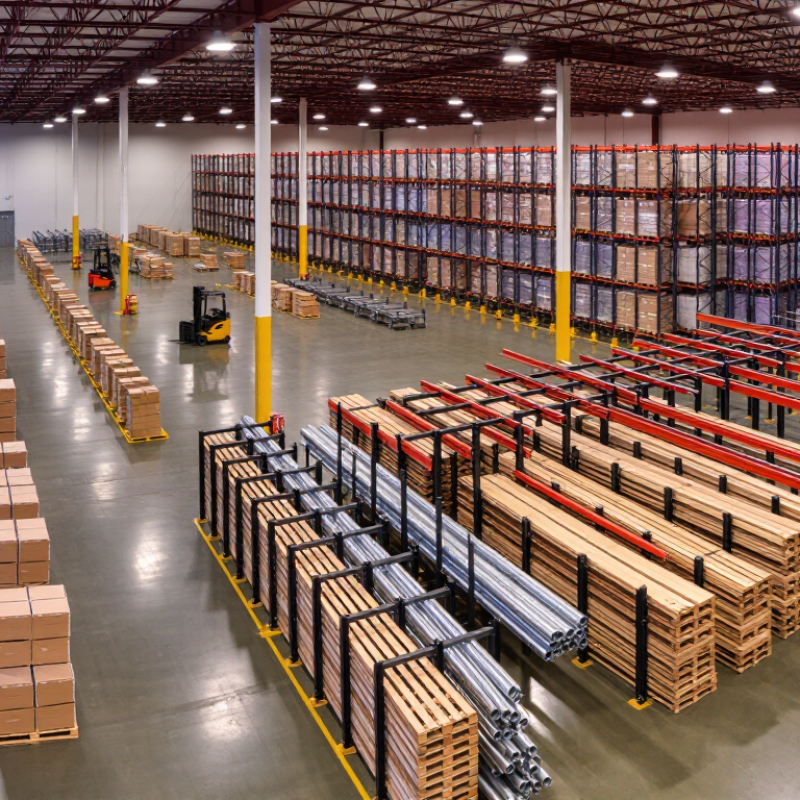
Cantilever Racking Long or bulky goods rest on projecting arms, leaving the front of the rack open for loading. Upright columns, horizontal bases, cantilever arms, braces, and arm stops where needed. Open-face access; goods are typically handled from the front with suitable lifting equipment. Commonly used for lumber, pipe, sheet material, and other long loads. Arm spacing, load length, and load distribution must suit the stored items.

Note: System selection and load limits depend on the rack design, pallet or product dimensions, floor conditions, handling equipment, and applicable safety requirements. Use the rack supplier’s specifications and have the installation assessed by a qualified professional.

The Main Types of Warehouse Racking Systems

The Main Types of Warehouse Racking Systems

Selective pallet racking gives workers direct access to each pallet. It is a common choice when a warehouse holds many product lines with modest quantities of each. The trade-off is wider aisles, which can reduce storage density.

Double-deep racks place pallets two positions deep, saving aisle space but requiring equipment that can reach the rear pallet. Access is direct.

For long or awkward loads, cantilever racks use projecting arms instead of front posts. Operators should check load dimensions and arm capacity before selecting a layout.

Drive-in racks let forklifts enter the storage lane, making them useful for large batches of similar goods.

Drive-through systems allow access from both ends, which can support a more orderly loading sequence.

Push-back racks move pallets along inclined rails, while pallet-flow racks use rollers to move them toward the picking face. Both systems can improve storage density, but their moving parts need inspection.

The right choice depends on inventory rotation, pallet condition, forklift turning space, and replenishment habits. A tidy floor plan can still mislead; test the proposed aisle widths and picking sequence with actual equipment and loads.

How Racking Systems Differ in Access, Capacity, and Space Use

Warehouse racking systems differ in how quickly workers reach a pallet, how much weight each bay holds, and how much floor space remains for movement. Selective pallet racking gives direct access to every stored pallet. A forklift can retrieve a specific load without shifting others. That convenience comes with wider aisles and lower storage density.

Drive-in racking uses fewer aisles by letting forklifts enter the rack structure. It suits large batches of similar goods, but access is less flexible: the last pallet placed may be the first one blocked. Push-back systems store pallets on nested carts, while pallet-flow racks use gravity rollers to move loads forward. Both increase density. Flow lanes can support first-in, first-out handling, though rollers need suitable loads and routine inspection.

Access matters.

Capacity is not just a rack’s advertised rating. Beam levels, upright frames, pallet dimensions, floor condition, and load distribution all affect safe use. A narrow aisle may fit more rack rows, yet slow turning forklifts or create awkward picking points. Measure actual pallets, including overhang, before choosing a layout.

Small details matter.

A plan can look efficient on paper and still feel cramped beside a staging area. That trade-off is easy to miss. Walk the proposed routes with the equipment and load sizes used in daily operations; real traffic often exposes a pinch point that drawings hide.

Factors to Consider When Selecting a Racking System

Selecting a warehouse racking system starts with the inventory, not the rack’s appearance. Record each pallet’s loaded weight, dimensions, and turnover rate. Then compare those details with the clear height, floor condition, column locations, and sprinkler layout. A selective rack gives direct access to every pallet, while drive-in or high-density designs trade some access for more storage positions. That trade-off can slow picking if fast-moving goods sit behind slower stock. Measure twice. Also map forklift turning paths and aisle widths on the actual floor plan; a few centimeters can affect safe maneuvering. Have a qualified professional verify rack loads and structural requirements before installation.

Plan for change, but avoid buying capacity you cannot use. MHI’s 2024 Annual Industry Report found that 55% of surveyed supply chain leaders planned to increase technology investment. That figure signals a broader push toward adaptable operations, not a reason to automate every aisle. Ask whether future equipment will work with the proposed rack, and whether beam levels can be adjusted as product sizes change. Consider installation downtime, inspection access, and the cost of protecting rack ends from impacts. A useful comparison includes total usable pallet positions, picking time, and maintenance—not just the price per bay. One weak point in many plans: demand forecasts can be wrong. Leave room to revisit the layout.